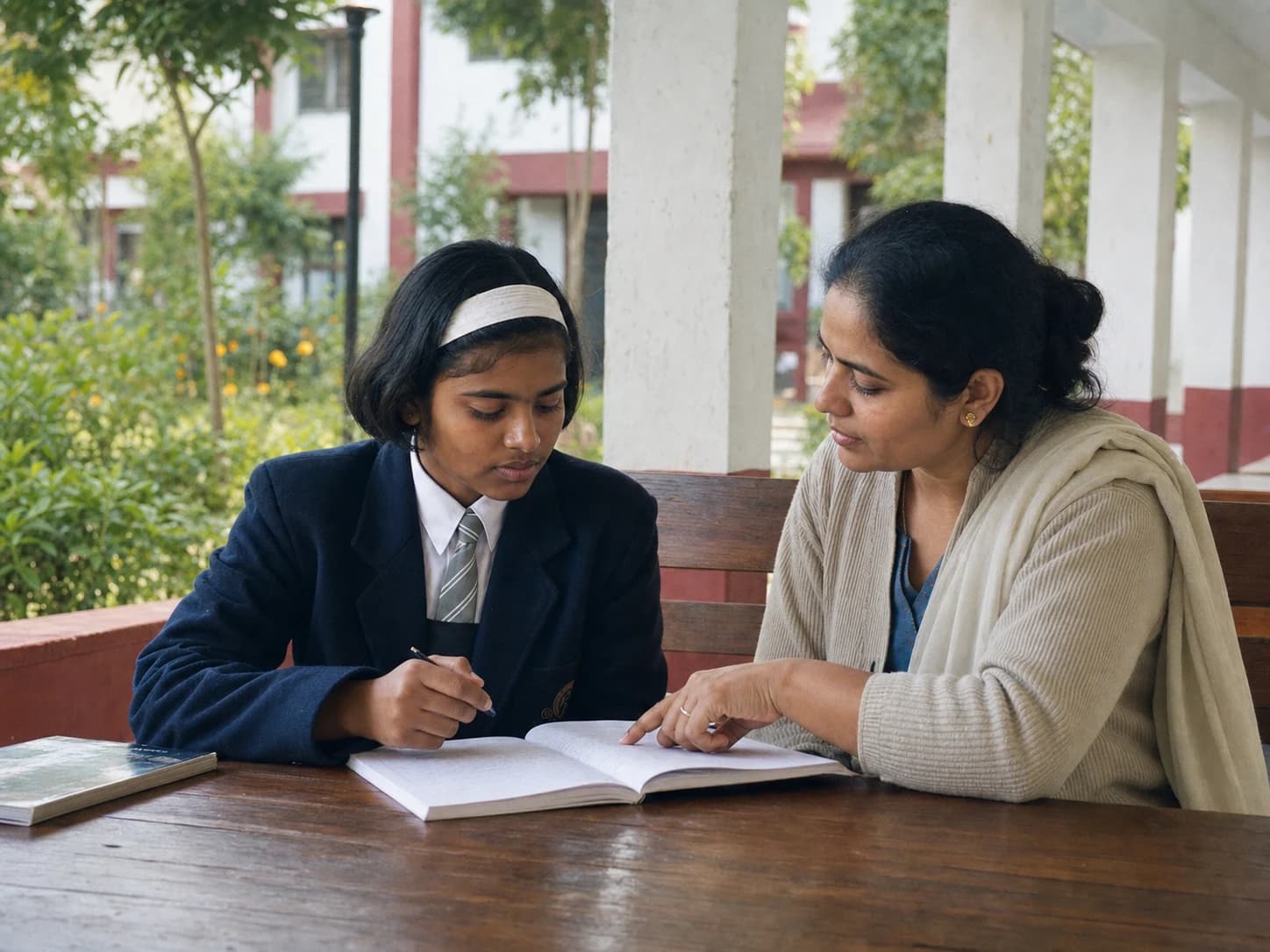
The School–Coaching Cycle: Rethinking How Indian Students Spend Their Day
A 2024–2026 examination of India’s school–coaching cycle: why it persists, what it costs students, and how schools and families can reclaim time for deeper learning.

At seven in the morning, a student leaves home for school. By late afternoon, the uniform has been exchanged for another set of clothes and the same chapters begin again in a coaching classroom. Dinner is hurried. Homework follows. Sleep is negotiated. Nothing about this day is unusual in urban India, which is precisely why it deserves attention.
The school–coaching cycle is often discussed as a contest between good and bad institutions. That is too simple. Families turn to coaching for understandable reasons: an entrance examination may be intensely competitive; a child may need subject help; a school may not offer enough practice; a coaching teacher may explain one idea unusually well. The difficulty begins when support becomes a second compulsory school day and repetition replaces learning.
Between the Ministry of Education’s 2024 coaching-centre guidelines and the school reforms visible in 2026, the public conversation has moved beyond whether coaching exists. The more useful question now is whether a student’s entire day is educationally coherent, physically sustainable, and worth the time it consumes.
Key takeaways
- Coaching is not one activity: targeted help, entrance preparation, and wholesale duplication solve different problems.
- The hidden cost of the cycle is often time: sleep, reading, sport, conversation, and the unhurried practice through which ideas settle.
- Schools reduce excessive coaching when classroom teaching, feedback, supervised practice, and doubt-clearing form one dependable system.
- Parents can judge value by the learning gap being solved, not by the reputation or weekly hours of a programme.
- A better system does not ban ambition; it refuses to make exhaustion the price of ambition.
Why the school–coaching cycle persists
Competitive examinations create a genuine demand for specialised preparation. Their speed, question patterns, and rank-based outcomes are not identical to the purposes of ordinary classroom learning. A student preparing for JEE or NEET may reasonably need deliberate practice beyond the school syllabus. The mistake is to treat every age, subject, and learner as though the same logic applies.
There is also a problem of trust. When parents cannot see how a school responds to weak understanding, they buy an additional layer of certainty. More worksheets feel safer than waiting for the next report card. Coaching then becomes an insurance policy, even when nobody has named the risk it is meant to cover.
Students themselves may prefer a teacher whose explanations are direct and whose practice material is organised. That preference should not be dismissed. It is useful feedback for schools: clarity, pace, worked examples, and timely correction matter. The sensible response is not a moral lecture about coaching but an honest audit of what the school day is failing to provide.
What the 2024 coaching-centre guidelines recognised
The Ministry of Education’s January 2024 model guidelines were sent to States and Union Territories for consideration within their own legal frameworks. They addressed registration, fees, infrastructure, misleading claims, counsellor support, mental wellbeing, and the need for co-curricular activity. Their existence reflected a basic reality: coaching had become large enough to require standards beyond academic outcomes.
The guidelines are not a single national ban, nor do they settle how every local centre operates. Education and implementation responsibilities are distributed, and families still need to check the rules that apply where they live. Their most important educational signal is broader: hours, safety, honest advertising, counselling, and student welfare belong in the same conversation as test results.
That signal should also reach schools. It would be inconsistent to scrutinise a coaching timetable while accepting a school timetable that leaves no space for movement, reading, friendship, or rest. Student wellbeing is not determined by the signboard outside the building; it is determined by the accumulated demands across the whole day.
Time, not effort, is the scarce resource
A serious student should expect to work. The issue is not whether effort is required but whether each hour has a distinct purpose. School lecture, coaching lecture, recorded lecture, and late-night revision can become four versions of the same exposure. Familiarity rises, but the student may still be unable to explain the principle, choose a method independently, or transfer it to a new problem.
Learning also has an interval structure. Students need time between explanation and recall, between an error and a second attempt, between reading and writing. A crowded day compresses these intervals. It creates the appearance of constant study while weakening the reflection that turns information into usable knowledge.
The lost hours are not merely recreational. Sleep supports attention and memory. Sport and walking regulate energy. Conversation helps adolescents test ideas and interpret experience. Wide reading develops vocabulary and background knowledge that no short examination module can supply. Removing these things can produce a busier learner without producing a better educated one.
Distinguish three very different needs
The first is repair: a student has a specific gap in algebra, reading, writing, or a foundational concept. Repair should be diagnostic, focused, and temporary. If months of tuition do not narrow the named gap, more of the same is not a plan.
The second is extension: a learner is ready for harder problems, competition preparation, or a subject the school cannot offer in sufficient depth. Extension can be valuable, but its success should be judged by growing independence rather than dependence on an instructor for every next step.
The third is duplication: the entire school programme is retaught because neither the family nor the student trusts the first encounter. Duplication is the most expensive form, both in fees and in time. When it becomes normal, the system should ask why two institutions are required to produce one coherent education.
Questions to ask
- What exact problem are these additional hours meant to solve?
- What evidence would show that the support is working?
- Which part of the programme is genuinely new rather than repeated?
- What has been displaced from the student’s week to make room for it?
What schools can change without waiting for policy
A school cannot remove competition from the wider system, but it can reduce avoidable duplication. Strong lessons make the structure of a subject visible. Low-stakes checks reveal misunderstanding early. Scheduled doubt-clearing gives students a place to return with a half-formed question. Supervised study teaches them how to practise rather than merely assigning more practice.
Schools should also be precise about where their responsibility ends. If a senior student is preparing for a competitive examination, families deserve a realistic account of what the school timetable covers, what specialised preparation may still be needed, and how the two schedules can coexist. Overpromising drives students into improvised, exhausting arrangements.
The most credible school response is evidence: sample timetables, assessment calendars, examples of feedback, support plans after weak performance, and protected time for sport and rest. Parents do not need to hear that coaching is unnecessary. They need to see that the ordinary school day is intellectually complete enough to command trust.
A family audit of the student’s week
For one ordinary week, record travel, school, coaching, homework, meals, sleep, exercise, and unplanned time. Do not begin by judging the child’s discipline. Begin by looking at the architecture of the week. Many families discover that the problem is not a lack of effort but the friction of travel, repeated assignments, and schedules designed independently of one another.
Then ask the student which hours produce learning and which merely produce attendance. Adolescents are not always accurate judges of what is easy or useful, but they often know where repetition has become empty. Their answer is evidence, not the final decision.
Remove or redesign one low-value commitment before adding another. Protect a credible bedtime. Keep at least some time that is not evaluated. Ambition survives these boundaries; in many cases, it becomes more durable because the student can finally see progress rather than only pressure.
Official sources and further reading
Policy information can change between academic sessions. These first-party sources were checked on 8 August 2026; families should confirm the latest circular for their own session.
Continue exploring the school behind the guide.
Read the full series
Explore six evidence-led essays on the future of schooling in India, covering 2024 to August 2026.
Review our academic approach
See how Radiant connects classroom teaching, practice, projects, and senior-school preparation.
Discuss your child’s schedule
Ask about the current timetable, supervised study, and academic support available at Radiant.