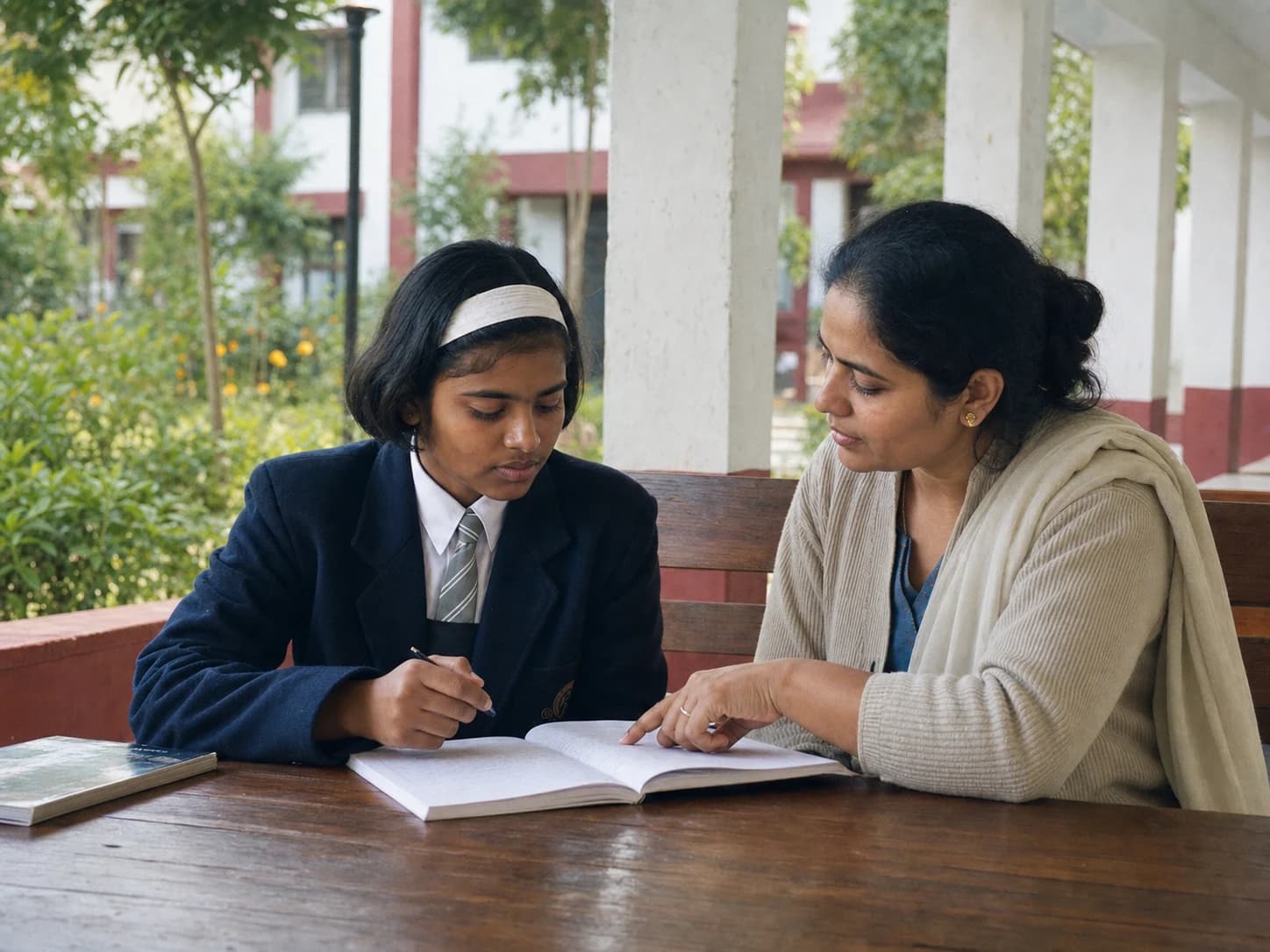
Education in the Age of AI: What Schools Must Continue to Teach
From 2024 to August 2026, AI entered Indian classrooms quickly. This essay asks what schools must keep teaching: knowledge, judgment, attention, writing, and responsibility.
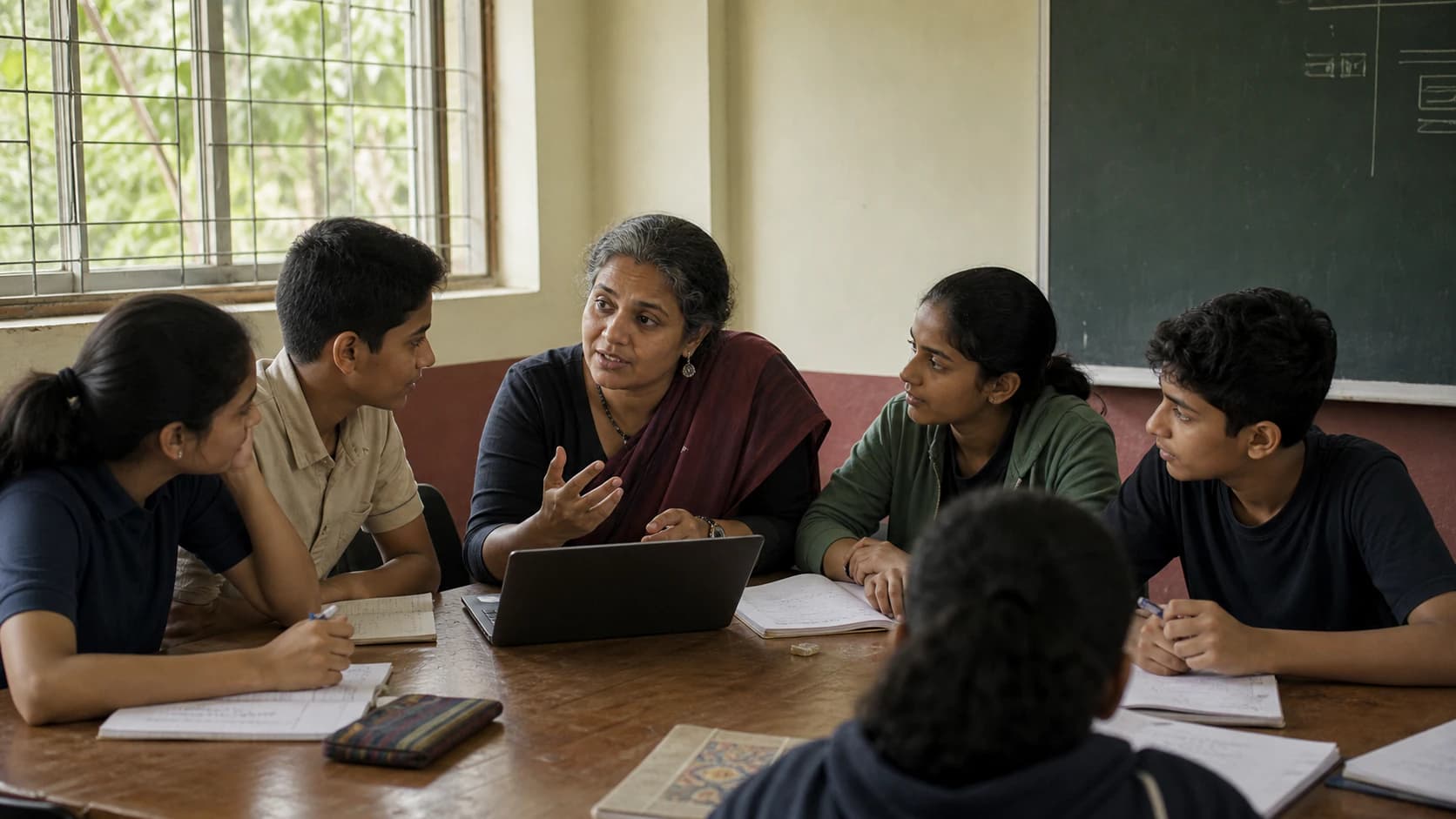
A student can now produce a tidy paragraph before learning how to form the argument inside it. A teacher can draft a worksheet in seconds and spend twenty minutes correcting its confident errors. A parent can ask a chatbot for a study plan and receive something plausible, polished, and entirely unsuited to the child. Artificial intelligence has made useful assistance abundant. It has also made the appearance of understanding much easier to manufacture.
Indian schools are not standing outside this change. By the 2026–27 session, CBSE had released a Computational Thinking and Artificial Intelligence curriculum for Classes III to VIII, while AI remained part of the skill-subject landscape in the secondary and senior-secondary years. The relevant question is no longer whether students will encounter AI. They already do, in school or beyond it.
The harder question is what education must preserve when fluent output becomes cheap. The answer is not nostalgia for a pre-digital classroom. It is a clearer defence of the capacities that allow a young person to use powerful tools without surrendering thought to them.
Key takeaways
- AI literacy should include capability, limits, source-checking, privacy, bias, and responsibility, not only prompt technique.
- Students still need substantial knowledge in memory because judgment depends on having something with which to judge.
- Schools should protect some unaided reading, writing, calculation, discussion, and practical work so that individual understanding remains visible.
- The strongest assignments make process observable through notes, drafts, oral explanation, evidence, and revision.
- Teachers become more important when information is abundant: their work shifts toward selection, questioning, feedback, and intellectual standards.
AI is already part of the school environment
A policy can determine when a school formally introduces a curriculum, but it cannot determine when a child first uses a generative tool. Students meet AI through search, phones, writing assistants, image tools, translation, coding platforms, and social media. Prohibition without education merely moves use out of sight.
CBSE’s 2026 work on computational thinking and AI for Classes III to VIII is therefore significant. Starting younger does not mean handing every child an unrestricted chatbot. It means teaching ideas at an age-appropriate level: patterns, data, stepwise reasoning, how computational systems work, what they can get wrong, and how people remain responsible for their use.
Schools need a shared vocabulary before they need a long list of applications. Students should understand the difference between assistance and authorship, between a source and a generated summary, and between an answer that sounds correct and one that can be verified.
Why knowledge still matters when answers are immediate
It is tempting to say that students no longer need to remember facts because a device can retrieve them. This confuses lookup with thought. A person recognises an implausible date, a weak analogy, a missing cause, or a mathematical impossibility by comparing it with knowledge already held. Without that internal structure, every fluent answer looks equally convincing.
Memory should not be reduced to mechanical recitation. It includes vocabulary, number relationships, historical sequence, scientific models, literary references, and the repeated examples that make new ideas intelligible. These form the mental material from which reasoning is built.
AI may change which facts deserve emphasis and how practice is designed. It does not eliminate the need for a rich foundation. In fact, unreliable abundance raises the value of well-organised knowledge: the student who knows more can ask better questions, detect contradictions sooner, and use the tool with greater independence.
Protect attention and some unaided work
Deep reading is partly the ability to remain with a difficult passage before escaping to a summary. Mathematical confidence grows when a student tolerates an unproductive first approach and tries another. Writing clarifies thought because the writer must decide what belongs, what follows, and what remains unsupported. A tool that removes every moment of friction can also remove the moment in which learning occurs.
For this reason, schools should designate some work as unaided. A handwritten explanation in class, a short oral defence, mental estimation, a laboratory observation, or a discussion of a text gives the teacher a clean view of what the student can currently do. This is not punishment. It is diagnostic honesty.
Other work can invite AI openly. Students might compare two generated explanations, trace the source of a factual claim, improve a weak answer, test a piece of code, or document how a prompt changed. The distinction should be explicit: sometimes the goal is to build the learner’s own capacity; sometimes it is to practise responsible tool use.
Verification is a discipline, not a final click
Telling students to ‘check the answer’ is inadequate unless they know how. Verification requires identifying the kind of claim being made, locating an appropriate primary or authoritative source, comparing dates and definitions, and deciding whether the evidence actually supports the sentence.
A science claim, a quotation, a court judgment, a current examination rule, and a historical interpretation require different checks. Students should learn why the first search result is not automatically the best source, why a citation can be invented, and why a correct sentence can still be misleading when context is removed.
This work belongs across subjects. In English, a student can examine whether quoted lines exist. In social science, the class can distinguish a government notification from commentary about it. In science, they can compare a broad claim with the conditions of the experiment. AI literacy becomes substantial when it improves ordinary scholarly habits.
Questions to ask
- Can the student state which parts were produced with AI assistance?
- Can every factual claim be traced to a suitable source?
- Can the student explain the answer without reading the generated wording?
- What private, personal, or copyrighted material must not be entered into the tool?
Assessment must reveal the path, not only the product
A polished final submission has become weak evidence of individual understanding. Schools do not need to abandon take-home work, but they do need more visible process. Topic proposals, reading notes, source lists, in-class outlines, drafts, teacher conferences, and short oral questions make the development of an idea harder to outsource and easier to support.
The purpose is not to police every sentence. Detection software is too uncertain to carry that burden, and a culture of constant suspicion damages trust. Better task design asks students to use local observations, class discussions, specific data, or earlier feedback. This material requires attention and ownership.
Assessment should also acknowledge legitimate assistance. A student who uses a tool to improve grammar after composing an argument is doing something different from submitting an argument they cannot explain. Clear disclosure rules are more educational than vague prohibitions because they teach students to describe their process honestly.
What teachers and schools must continue to do
Teachers establish what good work looks like. They select examples, notice misconceptions, hear uncertainty in a student’s explanation, and decide when to offer a hint rather than an answer. These are judgments about a particular learner in a particular moment. Faster content generation does not replace them.
Schools must give teachers time to make those judgments. If AI merely increases the quantity of worksheets, presentations, and reports, it will intensify a weak version of schooling. Its better use is to reduce routine preparation where appropriate and return time to feedback, discussion, reading student work, and planning responsive lessons.
The enduring curriculum is therefore both old and new: knowledge, language, number, evidence, attention, imagination, ethical responsibility, and an honest understanding of computational systems. A school prepared for AI is not the one with the most screens. It is the one whose students can think clearly with a tool, without a tool, and about the difference.
Official sources and further reading
Policy information can change between academic sessions. These first-party sources were checked on 8 August 2026; families should confirm the latest circular for their own session.
- Computational Thinking and Artificial Intelligence, Classes III–VIIICBSE Academic Unit
- Curriculum for the Academic Year 2026–27CBSE Academic Unit
- National AI Literacy Campaign: YUVA AI for AllCBSE Academic Unit
- National Curriculum Framework for School Education 2023Ministry of Education, Government of India
Continue exploring the school behind the guide.
Read the full series
Explore the 2024–2026 series on assessment, learning, student time, choices, and school design.
Explore academics
See Radiant’s approach to subject knowledge, laboratories, projects, and guided study.
Talk with the school
Ask how digital tools, academic honesty, and student work are handled in the current programme.